TIMLG Protocol
A verifiable, slot-bounded commit-reveal protocol on Solana.
TIMLG couples deterministic on-chain settlement with a publicly verifiable 512-bit randomness pulse, wallet-level statistics, and a documentation set designed for technical verification.
What TIMLG is, in one picture
You commit a hidden bet. The protocol then publishes a public random pulse from NIST. You reveal your bet. The on-chain program decides win or lose deterministically. Tokens settle automatically.
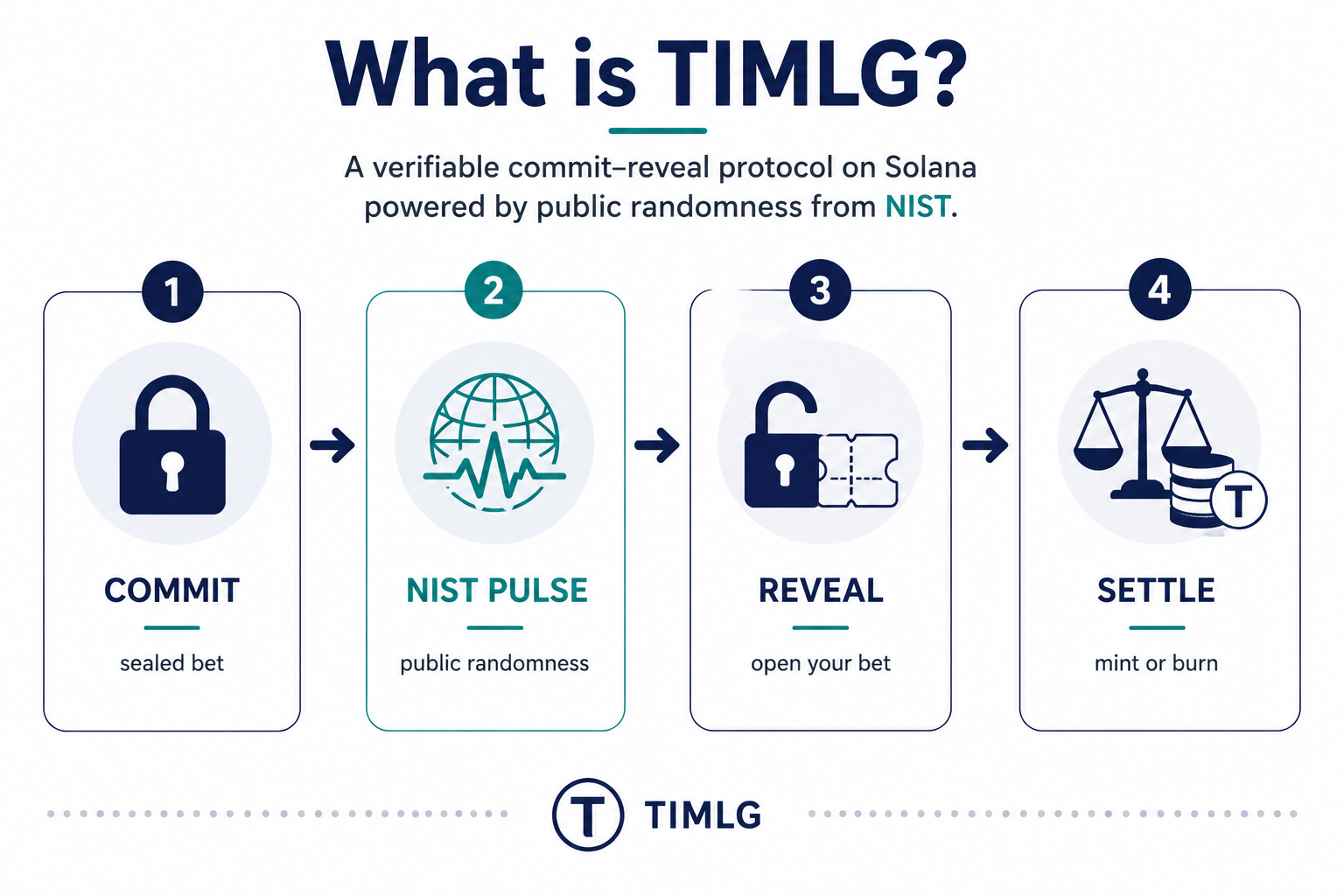
Read the full protocol overview →
How a round works
Every round is a slot-bounded sequence of windows. The order is fixed: commits close before the pulse arrives, the pulse closes before reveals expire, and settlement runs on top of the result.
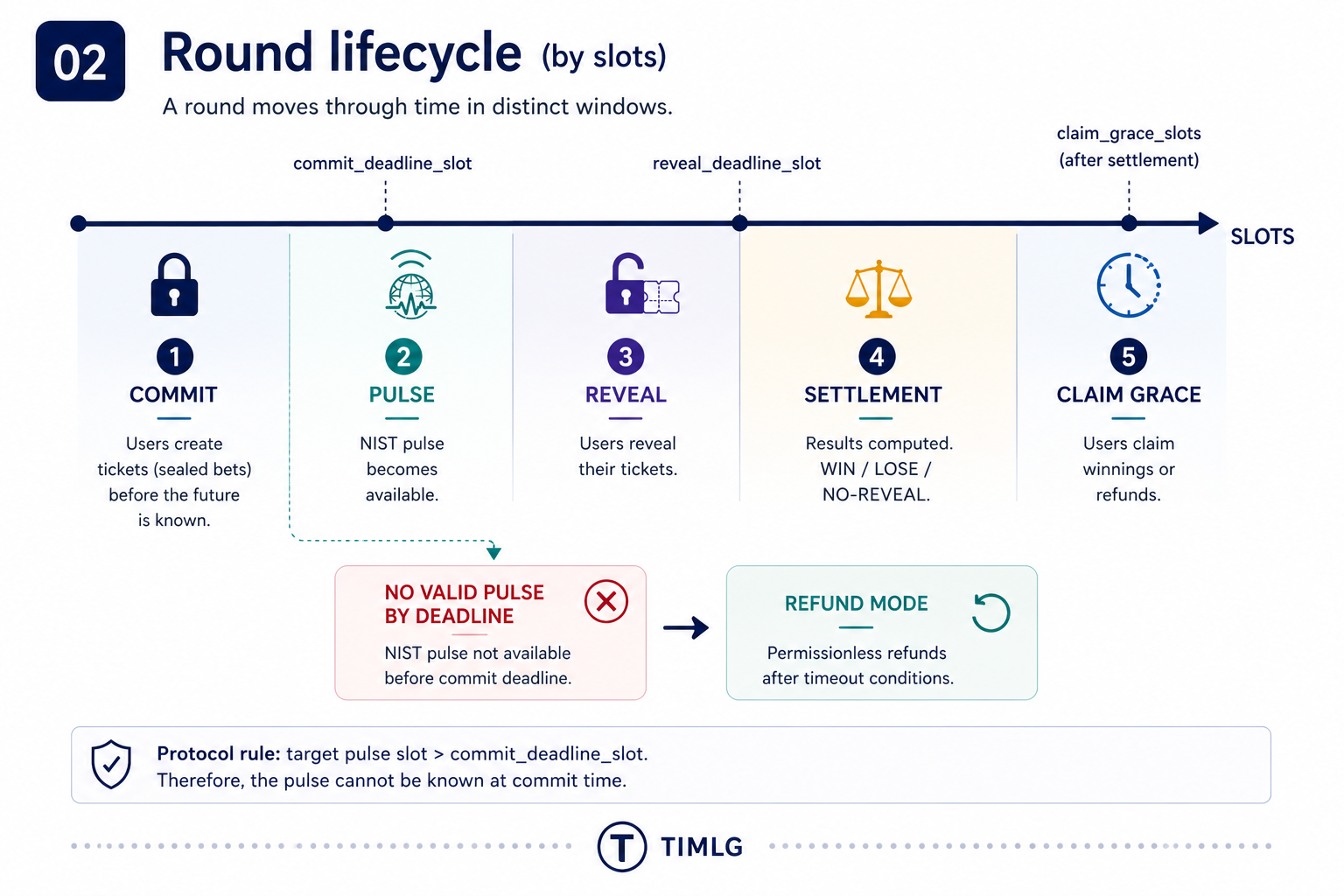
Read the lifecycle in detail →
Why nobody can cheat — the Hawking Wall
Commits must be sealed before the pulse becomes public. There is a wall between "what you can know when you bet" and "what the protocol will use to settle". The wall is enforced by Solana slots, not by trust.
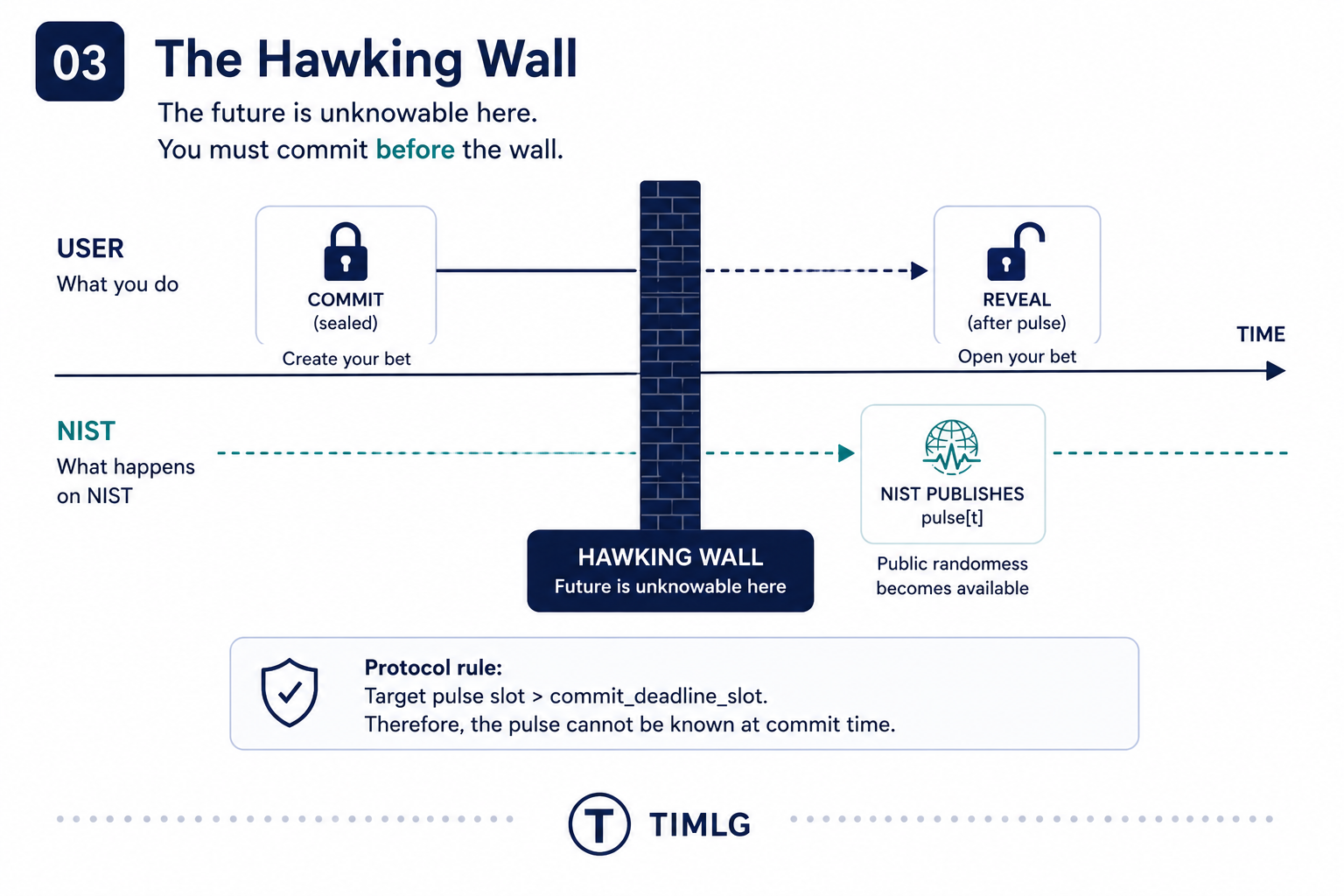
Where the randomness comes from
A set of independent oracles each fetches the same NIST Beacon pulse and signs it. The on-chain program only accepts the pulse when a threshold of those signatures agrees, and it verifies a cryptographic chain back to the previous accepted pulse. No single oracle can substitute the value.
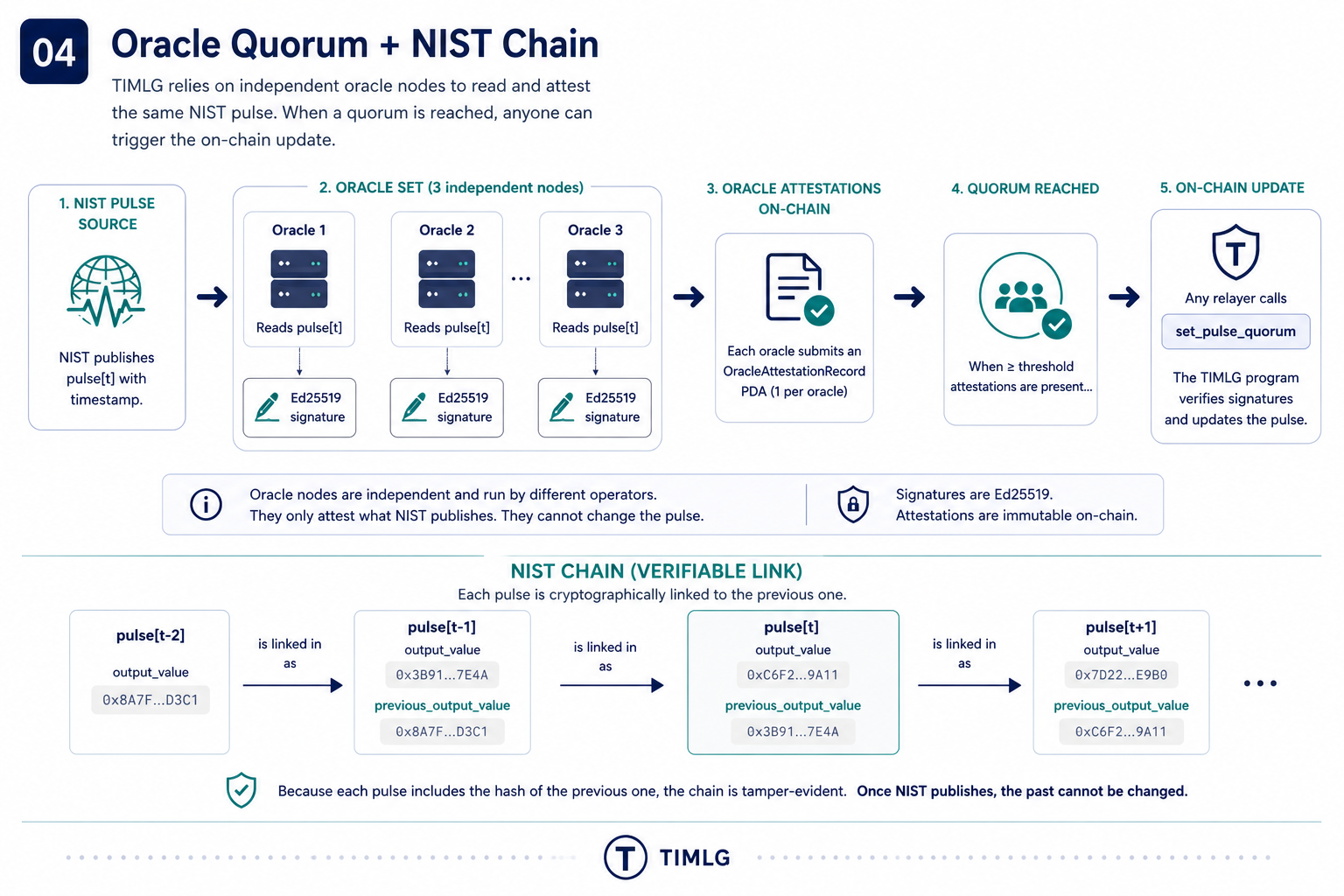
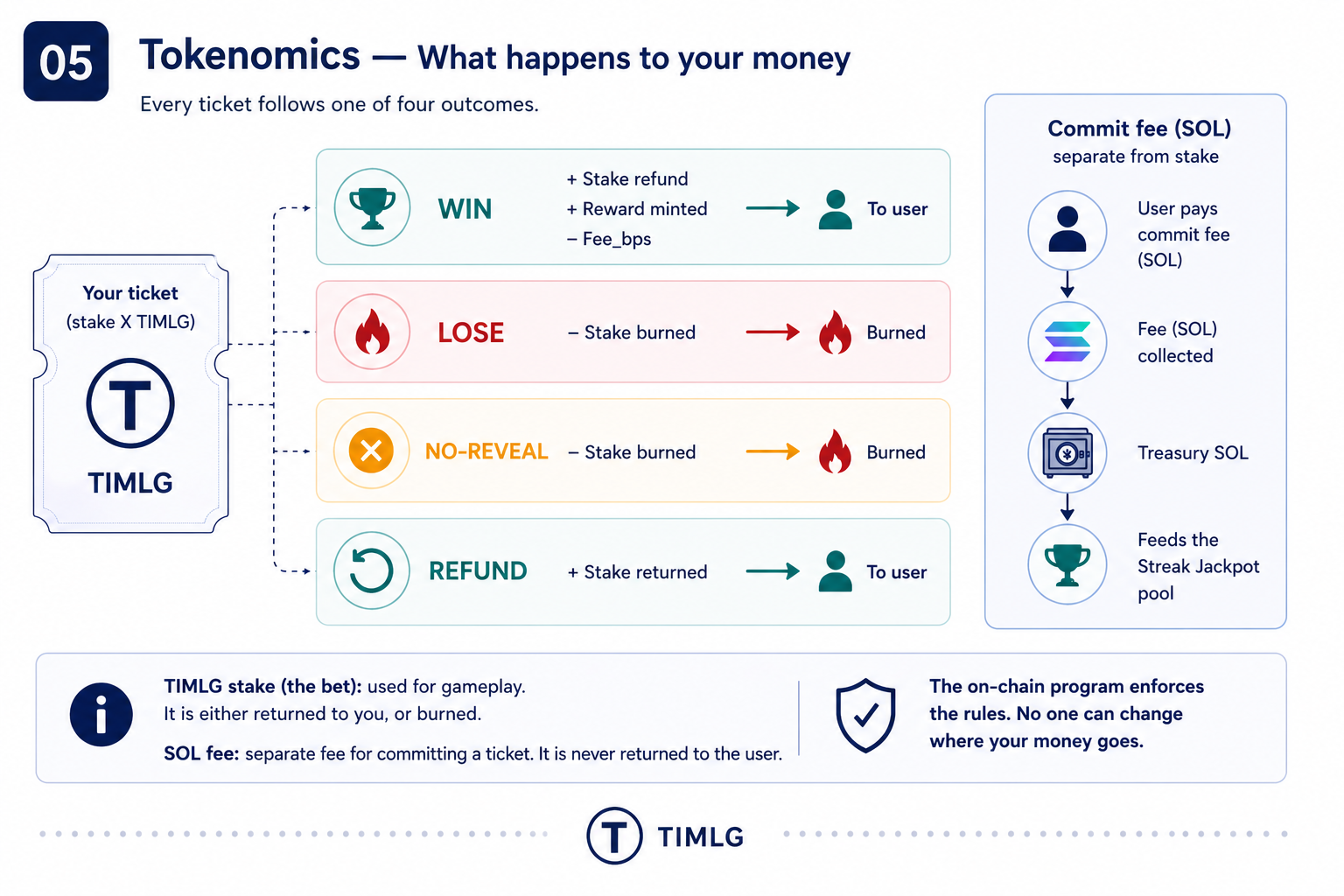
What happens to your tokens
Every ticket has four possible terminal states. Wins mint a reward and refund the stake. Losses and no-reveals burn the stake — the protocol is deflationary by design. Refunds are a safety fallback for oracle outages. The per-ticket SOL service fee funds a separate jackpot pool.
The Streak Jackpot
Every ticket commit pays a small SOL fee that accumulates in an on-chain pool. Anyone whose consecutive-win streak beats the global record can claim the entire pool in one transaction — and becomes the new record holder.
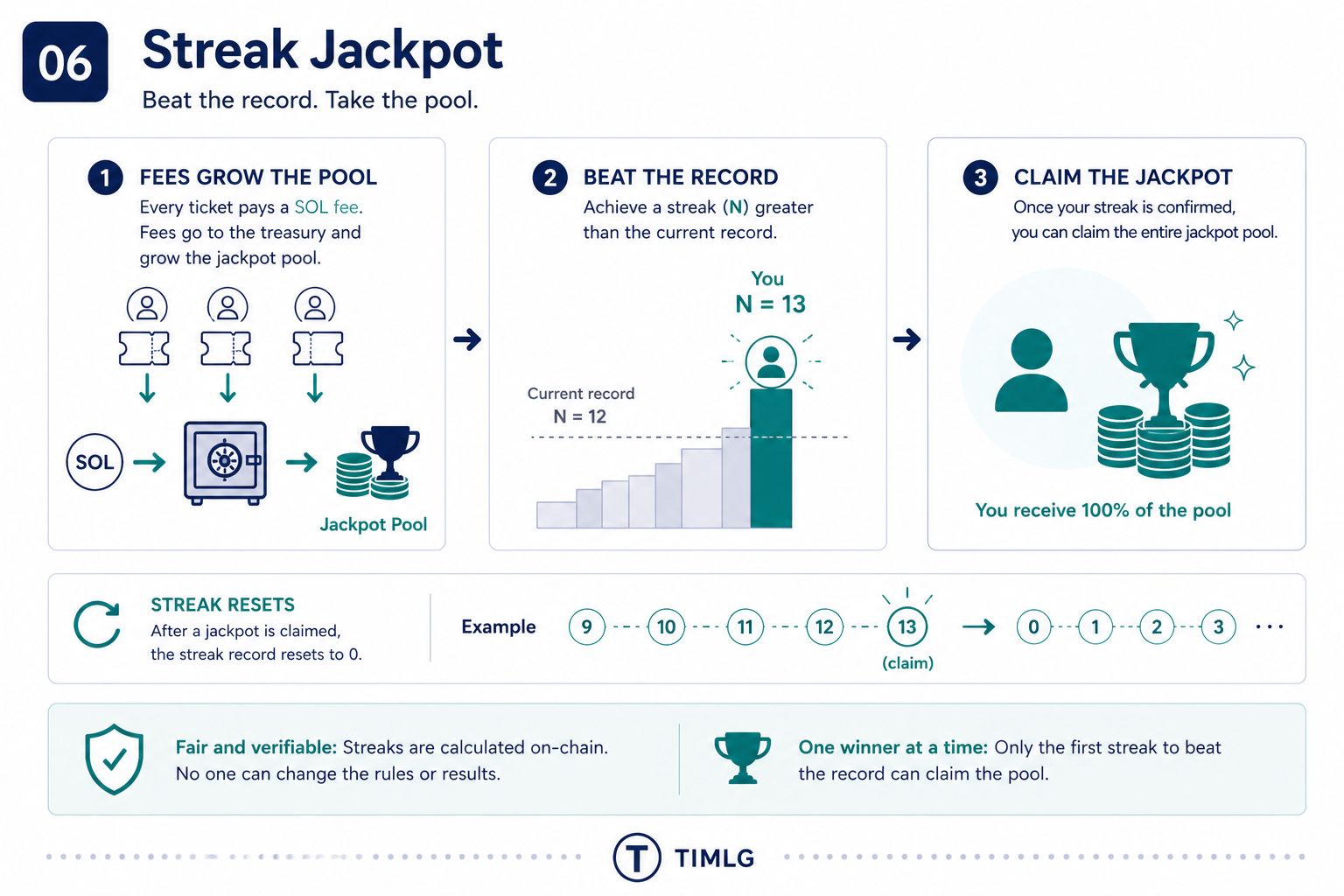
Read the Streak Jackpot mechanic →
Protocol snapshot
| Topic | Current Devnet MVP |
|---|---|
| Randomness flow | Commit window closes before the oracle pulse is published; the pulse is verified on-chain |
| Outcome model | WIN / LOSE / NO-REVEAL / REFUND |
| Settlement rule | WIN = claimable stake refund + reward mint; LOSE and NO-REVEAL = burn |
| Oracle model | OracleSet quorum (M-of-N Ed25519) with on-chain NIST chaining (output_value + precommitment) |
| Round creation | Permissionless, gated by an on-chain canonical-target rule |
| Wallet analytics | UserStats tracks cumulative counters and consecutive-win streaks |
| Streak incentive | StreakLeaderboard PDA + claim_streak_jackpot (active on-chain) |
Verifiable surfaces today
| Surface | What a reviewer can check |
|---|---|
| Lifecycle | Commit → pulse → reveal → settle → claim / refund / sweep / close |
| Economic routing | Stake escrow, deflationary burn, reward mint, fee routing, treasury surfaces |
| Account model | PDAs for config, rounds, tickets, stats, vaults, treasuries, oracle set, leaderboard |
| User history | Wallet-level counters and consecutive-win streaks via UserStats |
| Timing | Slot-bound deadlines, grace windows, and refund timeouts |
| Source code | Anchor program, IDL, and TypeScript SDK at github.com/richarddmm/timlg-protocol |
For technical readers
If you want to go deeper than the visual tour above:
-
Protocol Overview
Architecture, lifecycle, oracle quorum boundaries, and treasury surfaces.
-
Oracle Trust Model
Quorum-based pulse acceptance, on-chain NIST chaining, and the recovery mode.
-
Settlement and Tokenomics
Outcome routing, burn logic, fee model, and the streak jackpot funding source.
-
User Statistics & Streak Jackpot
Wallet-level counters, streak rules, and the on-chain jackpot claim flow.
Documentation policy
The site distinguishes clearly between:
- implemented MVP behavior (current Devnet deployment),
- future hardening (mainnet trajectory), and
- explicit out-of-scope material (privileged operational topology and key custody).
That distinction is deliberate. It keeps the protocol easier to review, easier to audit, and easier to evolve without rewriting past claims.
Downloads and historical references
The canonical specification of the protocol lives in the Architecture Overview and the rest of the Protocol section. The PDF documents below are kept for historical and external-citation reference; in case of any discrepancy, the live protocol pages and the on-chain program are authoritative.
- TIMLG Whitepaper v1.2 — Live audit integration and protocol dynamic hardening (February 2026)
- TIMLG Whitepaper v1.1 — Pre-multi-oracle revision (February 2026)
- TIMLG Whitepaper v1.0-beta — Initial protocol-implementation alignment (January 2026)
- TIMLG Whitepaper v0.1 — Initial conceptual draft (December 2025)
Source code: github.com/richarddmm/timlg-protocol.